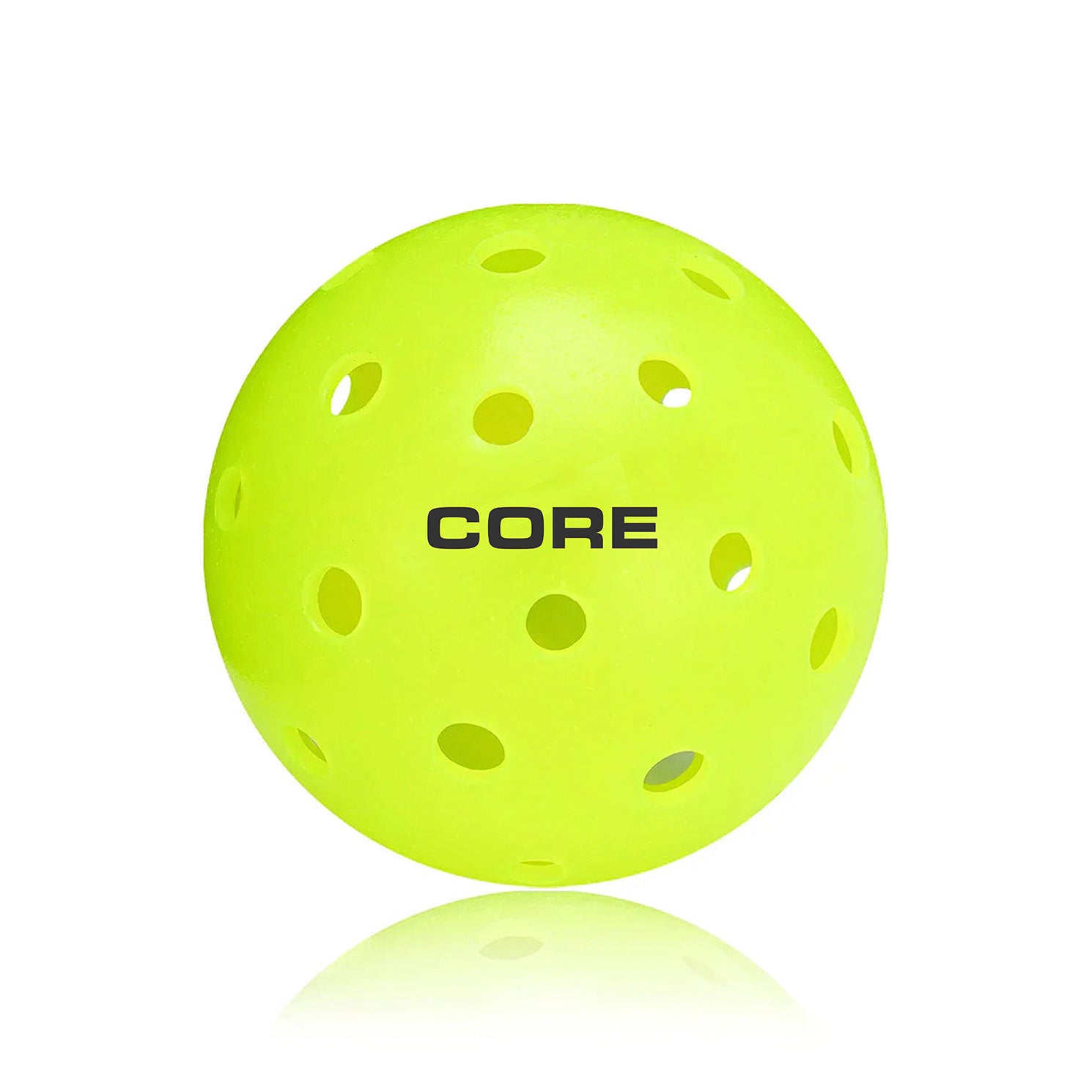



Pickleball balls take more punishment than almost any other piece of equipment on the court. Between high-velocity paddle impacts, abrasive asphalt surfaces, and fluctuating temperatures, even the highest-quality balls eventually lose their "pop" or crack.
Quick Summary: The 2026 Durability Standards
- Outdoor Balls: 5–12 games (Avg. 1 week of daily play)
- Indoor Balls: 20–40 games (Avg. 3–4 weeks of play)
- Top Cause of Failure: Cracking (Cold weather) or "Egging" (High-velocity impacts)
- Pro Tip: Replace your ball immediately if it fails the "36-inch Bounce Test" or develops soft spots.
How Long Do Pickleball Balls Last? (By Environment)
The lifespan of a pickleball is determined by its manufacturing method and the friction it encounters. While 2026 manufacturing standards have narrowed the gap between brands, your environment still dictates durability.
Outdoor Pickleballs
- Lifespan: 5–12 games.
- Why they fail: Outdoor courts are essentially sandpaper. As the ball's micro-texture wears down, it loses mass and becomes "faster" but less predictable. In temperatures below 50°F, the plastic becomes brittle, leading to structural cracks.
Indoor Pickleballs
- Lifespan: 20–40 games.
- Why they fail: Played on gym floors or smooth surfaces, these balls rarely crack. Instead, they "soften" over time. The plastic loses its elastic memory, resulting in a "dead" feel where the ball no longer bounces to the regulated height.
“As paddle technology advances and players hit with more power, we’re seeing a 15-20% decrease in average ball lifespan compared to three years ago. At CORE, we’ve shifted our R&D toward material formulas that maintain 'roundness' under high-stress play.”
— Angel Morales, Chief Product Officer at CORE Athletics
Brand Comparison: Which Ball Lasts Longest?
To help you budget your season, we’ve benchmarked the most popular balls in the 2026 market based on player feedback and lab testing.
| Ball Brand/Model | Avg. Lifespan (Games) | Primary Failure Mode | Best Use Case |
|---|---|---|---|
| CORE Indoor or Outdoor | 12–18 | Surface Abrasion | Tournaments / Max Durability |
| Onix Dura Fast 40 | 3–6 | Cracking (High Brittleness) | Pro Tournaments / Max Speed |
| Franklin X-40 | 6–10 | Softening / "Mushy" Feel | Recreational / All-Weather |
| Selkirk S1 | 8–12 | Out-of-Round (Wobble) | Consistency / Intermediate |
The 3 Signs It’s Time to Replace Your Ball
Don't wait for a ball to shatter to replace it. Playing with a "dead" ball ruins your timing and can lead to arm fatigue as you overcompensate for lack of bounce.
1. The "Egging" Test (Roundness)
High-level players often "egg" a ball—deforming it into an oval shape without cracking it.
The Test: Spin the ball in the air. If it "wobbles" or has an inconsistent flight path, it is out-of-round. Alternatively, roll it across a flat kitchen floor; if it doesn't roll in a perfectly straight line, it's dead.
2. The 36-Inch Bounce Test
USAPA standards require a ball to bounce between 30 and 34 inches when dropped from a height of 36 inches onto concrete.
The Test: Hold a new ball and your used ball at eye level (approx. 3 feet). Drop them simultaneously. If the used ball bounces more than 2-3 inches lower than the new one, the plastic has lost its elasticity and "pop."
3. The Squeeze Test (Soft Spots)
Press your thumbs into the poles of the ball (where there are no holes). If the ball feels "mushy" or stays slightly indented, the structural integrity has failed. This usually happens to indoor balls before they ever show visual damage.
Factors That Kill Your Pickleball Balls
- Extreme Cold: Plastics like PE and TPE have a glass transition temperature. Below 50°F, they lose flexibility. Using a "cold" ball is the #1 cause of cracking.
- Player Skill Level: A 4.5+ player hits with significantly more "dwell time" and force, stressing the plastic more than a casual player.
- Court Surface: Rough, unpainted asphalt acts like a grater, removing the ball's outer layer and reducing its weight, which changes its aerodynamics.
How to Make Your Pickleball Balls Last Longer
- Temperature Control: Never leave your equipment bag in a frozen or sweltering car. Keep balls at room temperature (65°F–75°F) until you reach the court.
- The Warm-Up Rotation: In cold weather, keep an extra ball in your pocket. Switch balls every 15 minutes to keep the plastic warm from your body heat, which prevents it from becoming brittle.
- Surface Awareness: If you play on rough, unpainted outdoor concrete, expect to replace balls 50% faster than those playing on dedicated acrylic-coated courts.
FAQs About Pickleball Lifespan
Why do my balls crack so fast in the winter?
Plastic molecules move slower in the cold, making the material rigid. When a paddle strikes a rigid ball, the plastic can't flex to absorb the energy, so it fractures.
Can I play with a ball that has a tiny crack?
No. Even a hairline fracture changes the compression of the ball, leading to "dead" bounces that ruin a competitive rally.
What is the difference between Rotomolded and Injection Molded balls?
Rotomolded balls are one-piece and generally fly faster but are more brittle. Injection-molded balls, such as the CORE Indoor or Outdoor models, are two pieces fused together; they are typically more durable and resist cracking better in varied temperatures.

Angel Morales is the Chief Product Officer at CORE Athletics and a veteran of the international pickleball circuit. With a background in materials science and product development, Angel works to bridge the gap between pro-level performance and long-term gear durability.
Ready for a ball that actually lasts? Explore the CORE Athletics Ball Collection -engineered for consistency, game after game.